Are you eyeing Canada for your next big career step or a fresh start for your family? Perhaps Saskatchewan, the "Land of Living Skies," has caught your attention with its robust economy and welcoming communities. If so, there’s some pivotal news from the Saskatchewan Immigrant Nominee Program (SINP) that you absolutely need to grasp for 2026. The rules of engagement have shifted, creating new strategic pathways and, yes, some tight deadlines for others.
Forget everything you thought you knew about applying on your own terms. Saskatchewan is getting specific.
Quick Guide
For 2026, the Saskatchewan Immigrant Nominee Program (SINP) has introduced a structured application system for specific industries. While "PriQority Sectors" (like Health and Tech) can apply year-round, Capped Sectors—including Trucking, Retail Trade, and Accommodation & Food Services—must adhere to these six critical intake windows.
Key Eligibility Rule: To apply during these windows, candidates must have 6 months or less remaining on their current Canadian work permit. Applications from those with more than 6 months of validity will not be accepted for these capped categories.
The Big Picture: Saskatchewan's Strategic Move for 2026
The total nomination allocation for 2026 stands at 4,761 spaces. This figure, although matching last year’s, will be distributed with far more strategic intent. This isn't just about numbers; it's about who gets in and when.
For years, provincial nominee programs (PNPs), such as the SINP, have been a lifeline for many seeking Canadian permanent residency. They allow provinces to select immigrants who best meet their local economic and labor market needs. But for 2026, Saskatchewan isn't just tweaking; it's undergoing a significant overhaul, reflecting a national trend towards more focused immigration.
The overarching goal is crystal clear: to align every single immigration nomination with the province's crucial Labour Market Strategy. This means some sectors are getting the red-carpet treatment, while others will navigate a new, more structured application process.
Game-Changer: "In-Canada" Rule is Out, Overseas is In!
This is monumental. It means the SINP now has far greater latitude to reach out to skilled individuals residing outside Canada, especially for those in critical, high-demand sectors. For countless professionals globally, this removal of a significant hurdle means a renewed sense of hope and a more direct shot at a Canadian future.
Remember the federal government’s directive in 2025 that mandated 75% of provincial nominees already be temporary residents in Canada? Well, in truly transformative news for 2026, that requirement has been lifted!
So, if you're reading this from another country, your chances of a direct nomination from Saskatchewan just got a considerable boost, especially if your skills are on their priority list.
Navigating the New Landscape: Priority vs. Capped Sectors
This is where the SINP's 2026 strategy really takes shape, dividing the playing field into two main categories:
1. The Red Carpet: Priority Sectors (At Least 50% of Nominations)
If your skills fall into one of these fields, congratulations—you're in Saskatchewan's VIP lounge. These sectors are deemed absolutely critical for the province's economic growth and public services.
- Who They Are: Healthcare, Agriculture, Skilled Trades, Mining, Manufacturing, Energy, and Technology.
- The Advantage:
- Open Access: Unlike other sectors, applicants in these fields can submit their applications at any time throughout the year. No waiting for specific dates, no frantic dashes to hit a narrow window.
- Work Permit Exemption: The strict "six-month work permit expiry" rule (more on that below) does NOT apply to you. This gives incredible flexibility.
- Special Reserve: A significant 750 spaces within this category are specifically earmarked for graduates of Saskatchewan post-secondary institutions who are already working in these vital sectors. This is a clear signal to international students: study here, work here, and we'll help you stay here.
If your profession aligns with these areas, your path to Saskatchewan permanent residency in 2026 just became much smoother and more predictable.
2. Saskatchewan SINP 2026 Intake Windows: Official Schedule
- Window 1: January 6, 2026 (This initial date is tentative.)
- Window 2: March 2, 2026
- Window 3: May 4, 2026
- Window 4: July 6, 2026
- Window 5: September 7, 2026
- Window 6: November 2, 2026
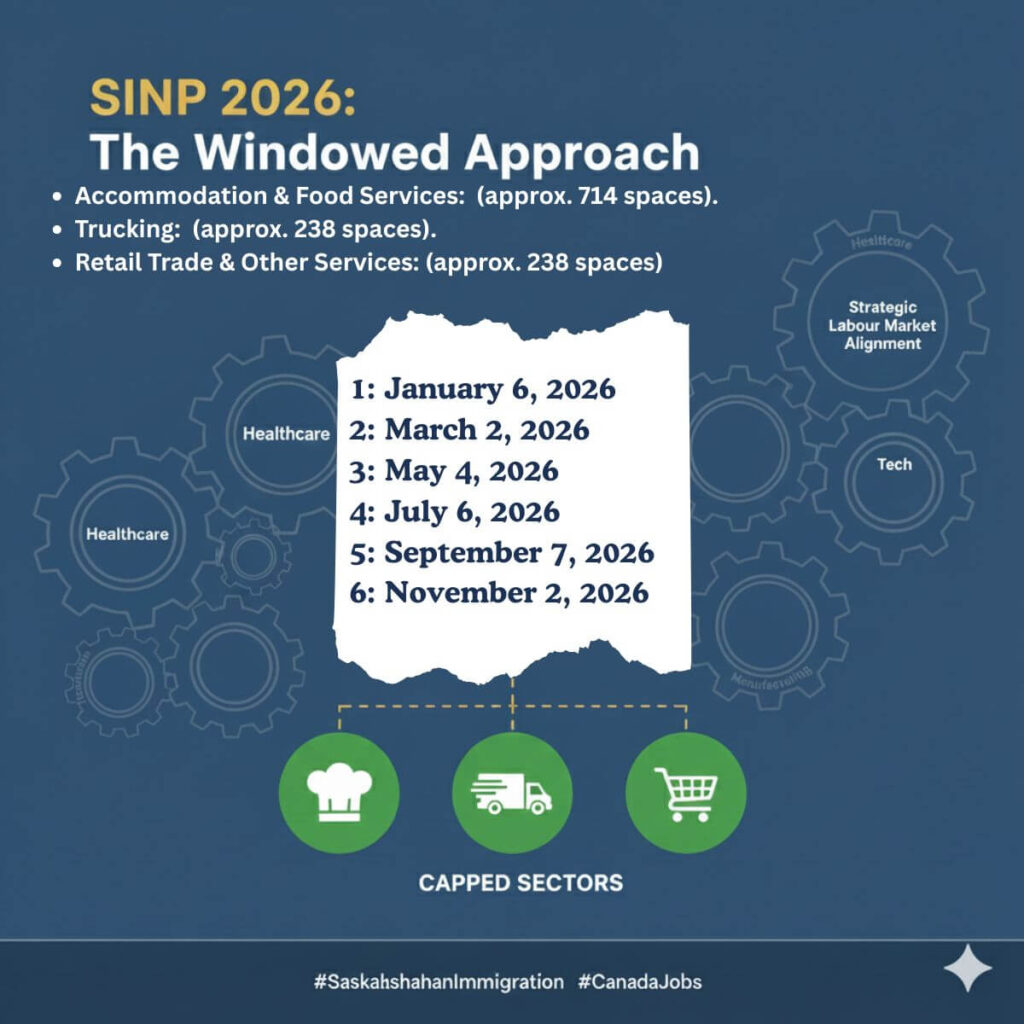
For other historically popular sectors, the game has changed entirely. To manage demand and ensure the bulk of nominations go to priority areas, Saskatchewan has introduced a system of strict intake windows.
- Who They Are: Accommodation & Food Services, Trucking, and Retail Trade.
- Accommodation & Food Services: Capped at 15% of the total nominations (approx. 714 spaces).
- Trucking: Limited to 5% of the total (approx. 238 spaces).
- Retail Trade & Other Services: Also capped at 5% of the total (approx. 238 spaces).
- The Crucial Calendar: Your 2026 Intake Windows. If you're an employer looking to nominate a candidate or a candidate working in one of these fields, mark these dates in bold on your calendar. These are the only times Job Approval Forms (JAFs) can be submitted:
These are not mere suggestions; they are the hard deadlines. Missing a window means waiting for the next, potentially losing out on limited spots.
The "6-Month Rule"—A Strict Filter for Capped Sectors
Beyond the intake windows, there's another critical condition for Capped Sector applicants: The "6-Month Rule."
You can only submit your application during an intake window if the candidate holds a Canadian work permit that has six months or less remaining until its expiry. If your work permit has, say, seven months left, your application will not be accepted during that window. This tightens the selection, ensuring that those closer to their work permit expiry are prioritized. It's a strategic move to manage the flow of applications and focus on those with a more immediate need for PR.
What Happens When Caps Are Hit?
The numbers for each capped sector (714, 238, 238 spots respectively) are finite. Once a sector reaches its allocated limit for the year, that's it. Applications for that sector may be paused or halted until the next program year. This underscores the need for swift action and meticulous preparation if you fall into one of these categories. These windows are not just opening; they're closing, and quickly.
Why These Changes? A Deeper Look
The Saskatchewan government isn't just creating hoops to jump through. These changes are a calculated move to ensure the SINP truly serves the province's evolving needs. By prioritizing certain industries and managing others through intake windows, they aim to:
- Address Critical Shortages: Ensure a steady stream of talent for essential services like healthcare and growing industries like technology and mining.
- Strategic Distribution: Prevent "over-subscription" in sectors that might be easy entry points but not long-term strategic priorities for the province's growth.
- Labour Market Alignment: Guarantee that immigration directly supports Saskatchewan's long-term economic plans and job creation efforts.
Crucial Procedural Updates for 2026
Beyond the sector-specific changes, the SINP has also refined some general application rules designed to offer a bit more flexibility and clarity for nominees:
- Nomination Certificate Extensions: If you receive a nomination certificate, you now have a more generous 90 days (an increase from previous, shorter limits) to request an extension if it expires. This provides a crucial buffer for applicants navigating federal processing times.
- Job Loss Protection: If, unfortunately, a nominee loses their job or their employment terms change after receiving a nomination, they now have 45 days to find a new eligible job offer. Even better, there's a possibility of applying for two additional 45-day extensions, offering a total of 135 days to secure new employment. This is a compassionate and practical adjustment that recognizes the realities of the job market.
Your Call to Action For Saskatchewan Immigration 2026
Given these sweeping changes, a passive approach to Saskatchewan immigration is no longer viable. Here's what you need to do:
- Identify Your Sector: Are you in a "Priority" or "Capped" sector? This fundamentally dictates your application strategy.
- Mark Your Calendar: If you're in a Capped Sector, those window dates are non-negotiable.
- Check Your Work Permit: If you're currently in Canada, be acutely aware of your work permit's expiry date.
- Prepare Diligently: Gather all documents, ensure your NOC code aligns perfectly, and if needed, get your language tests done.
- Stay Informed: Immigration rules can change. Bookmark the official sources below and check them regularly.
Official Saskatchewan Immigration Resources (Verify Everything Here!):
To navigate these changes accurately, always consult the official Government of Saskatchewan portals. These are your most reliable sources for up-to-the-minute information:
- SINP Immigration FAQs (Your Go-To for 2026 Policy Details): https://www.saskatchewan.ca/residents/moving-to-saskatchewan/live-in-saskatchewan/by-immigrating/saskatchewan-immigrant-nominee-program/immigration-faqs
- SINP Processing Statistics (Track Intake Window Closures & Remaining Spots): https://www.saskatchewan.ca/residents/moving-to-saskatchewan/live-in-saskatchewan/by-immigrating/saskatchewan-immigrant-nominee-program/sinp-processing-statistics
- Occupation Requirements (Check if your NOC is Priority, Capped, or Excluded): https://www.saskatchewan.ca/residents/moving-to-saskatchewan/live-in-saskatchewan/by-immigrating/saskatchewan-immigrant-nominee-program/browse-sinp-programs/applicants-international-skilled-workers/occupation-restrictions-and-requirements
- International Skilled Worker EOI System (How the Points System Works): https://www.saskatchewan.ca/residents/moving-to-saskatchewan/live-in-saskatchewan/by-immigrating/saskatchewan-immigrant-nominee-program/browse-sinp-programs/applicants-international-skilled-workers/international-skilled-worker-eoi-system
The 2026 SINP changes represent a robust, yet more complex, system. For those whose skills align with Saskatchewan's core needs, the opportunities have become more direct and accessible, especially for those applying from abroad. For others, careful planning, meticulous timing, and an eagle eye on deadlines will be the keys to success. Don't leave your Canadian dream to chance; arm yourself with this knowledge and plan your next move strategically.
Checklist For Saskatchewan 2026 Immigration
Whether you are an employer or a candidate, the 2026 rules require precision. Use this checklist to ensure you’re ready before the next window opens.
For Candidates: Getting Your Paperwork in Order
- Verify Your Sector: Determine if you are Priority (Healthcare, Tech, Agriculture, etc.) or Capped (Trucking, Retail, Food Services).
- Check Your Work Permit Expiry: If you are in a capped sector, confirm that your permit has 6 months or less remaining.
- Update Your Language Test: Ensure your IELTS, CELPIP, or PTE results are less than 2 years old. (Minimum CLB 4 required for most streams).
- Educational Credential Assessment (ECA): If your degree is from outside Canada, make sure your ECA is ready.
- Detailed Reference Letters: Collect employment letters that list specific duties, hours, and salary. Generic letters are a common reason for rejection.
For Employers: Preparing for the Intake Window
- Mark the Calendar: Save the six intake dates (starting Jan 6, 2026) in your corporate calendar.
- Submit the JAF Early: Job Approval Forms (JAF) should be submitted as soon as a window opens. Spots are limited!
- Maintain Conditions: Remember that once a Job Approval Letter (JAL) is issued, you cannot decrease the wage or significantly change the job duties.
- Verify NAICS Code: Ensure your business is registered under the correct NAICS code (e.g., NAICS 72 for Food Services) so your application goes into the right stream.
The Final Step: The "60-Day Sprint"
- Monitor Your Email: Once you receive an "Invitation to Apply" (ITA), you only have 60 days to submit a complete online application. Don't wait until day 59 to start scanning documents!